

Kurzes Urteil: A fantasy scenario feels real when the setting does half the work. Give your world a place, two or three rules, and one small detail that only fits there — and the image stops looking like a costume in a blank room. In this guide you will build three settings (a tavern, a starship cabin, an academy library), learn the three rules every invented world needs, and run a 15-minute workflow that turns one setting into three finished images. The setting is the story: change the room and you change the scene.
Contents
- What worldbuilding actually is
- Three settings that work
- The rules every invented world needs
- Small details that sell a world
- The 15-minute workflow: ein Setting, three images
- What breaks a world
- Consent and safety
- Frequently asked questions
1. What worldbuilding actually is
Worldbuilding is not lore. It is not a ten-page history of a kingdom nobody will read. For a generated image, worldbuilding is three things: a place, a rule, and a detail. The place tells the viewer where they are. The rule tells them how this world behaves. The detail proves the place is lived in. That is all an image can show, and it is all an image needs.
Most fantasy images fail in the same way. The character is dressed for a tavern, a starship, or a library — and standing in a grey studio void. The costume says one thing, the background says nothing, and the viewer’s brain notices the contradiction before it notices the character. A plain backdrop is not neutral. It is a statement: this person belongs nowhere.
Here is the test. Cover the character with your hand and look only at the background. Can you tell where the scene happens? If the answer is no, the setting is not doing its job. A blank wall is a story with the pages torn out, because the setting is the story.
Good news: you do not need to describe a whole world. You need one room that behaves like a room. A tavern has a bar, a fire, and a door that someone just came through. A starship cabin has a porthole, a panel that blinks, and a bunk that is unmade. An academy library has shelves, a ladder, and a desk with one book left open. Three objects, placed with intent, are enough. The viewer’s imagination fills in the rest — that is what it is for.
2. Three settings that work
Start with settings you can describe in one sentence. If the sentence needs a comma and a footnote, the setting is too complicated to generate cleanly. Here are three that work, with the sentence that defines each one.
| Umgebung | One-sentence definition | Best for | Watch out for |
|---|---|---|---|
| The tavern | A warm room with a fire, a bar, and a door to the cold outside. | Mood, candlelight, layered clothing, relaxed poses | Too many props; the room becomes a museum |
| The starship cabin | A small metal room with one round window on the stars. | Clean lines, cool light, contrast between skin and steel | Techno clutter; every panel competes for attention |
| The academy library | A tall room of shelves, a ladder, and one desk lamp. | Scholarly costumes, books as props, vertical framing | Books that look like wallpaper; no focal point |
The tavern is the most forgiving setting in the set. Firelight hides small mistakes, wood and cloth forgive soft edges, and a character can lean, sit, or stand without the pose looking staged. Describe the fire first — “warm firelight from the left, shadows on the right” — and the rest of the room arranges itself around it.
The starship cabin is the strictest. One light source, one window, one bed or chair. The strength of the setting is contrast: warm skin against cold metal, a soft blanket against a hard wall. Keep the background to three objects at most. If you list five panels, three screens, and a blinking console, the generator will fill the frame with machinery and your character will be a passenger in her own scene.
The academy library rewards vertical thinking. Tall shelves make a tall frame feel natural, and a ladder gives the character a reason to reach, climb, or look up. One desk lamp is the light; everything else is shadow. The trick is the open book: one book, left open on the desk, tells the viewer someone was here a minute ago. An open book is a story that has already started, because the setting is the story.
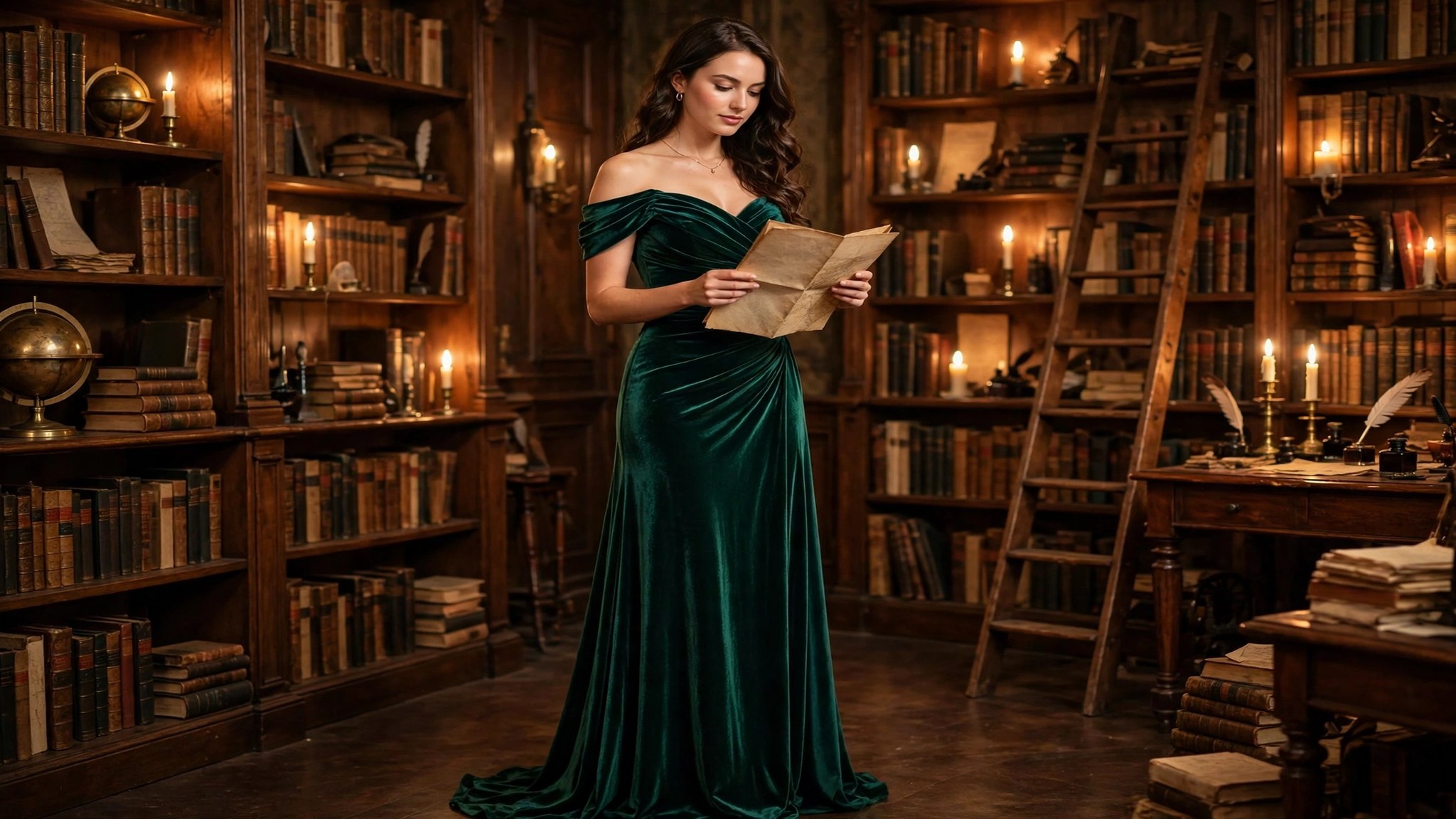
Pick one setting and stay with it for a whole set. Three images in the same tavern teach you more about the tavern than three images in three different rooms. The first image establishes the place. The second explores it. The third breaks one small rule of it — a door left open, a glass knocked over — and the world feels lived in instead of built.
3. The rules every invented world needs
Every invented world needs rules, and it needs very few of them. Two or three, written down before you generate anything. A rule is a sentence that starts with “in this world” and ends with something the image can show.
Examples that work: “In this tavern, nobody locks the door.” (The door is ajar; anyone could walk in.) “In this cabin, the lights dim after midnight.” (Low light; the porthole glows.) “In this library, candles are forbidden.” (Electric lamps only; no open flame near the books.) Each rule gives the generator something visible to do. A rule nobody can see is not a rule — it is a note in a drawer.
Rules also protect you from yourself. When you change a detail mid-set — the tavern gains a chandelier, the cabin gains a window that was not there — the world stops being one world and becomes three unrelated pictures. Write the rules down, keep them in front of you, and check each new image against them. One line of rules saves more credits than any prompt trick, because every image that breaks a rule is an image you regenerate.
The third job of a rule is to create the scene’s tension. A rule that is about to be broken is a story. The tavern door is open and someone is standing in it. The cabin light is dim and someone is still awake. The library forbids candles and there is a candle on the desk. You do not need to explain the tension. Show the rule, show the break, and let the viewer feel it.
4. Small details that sell a world
Big details describe a world. Small details prove it. A tankard with foam still on it. A coat thrown over a chair instead of hung up. A map with one corner folded down. These are the details that make a viewer believe the room existed before the picture was taken.
The best small details do two jobs at once: they place the scene and they place the character. A folded map says the character is planning a journey. A half-finished letter says she was interrupted. A pair of boots by the door says she came in from the cold. Ask of every prop: what does it say about the person, not just the place? A prop that only decorates is a prop you can delete.
Keep the count low. Three small details per image is the ceiling; one or two is usually better. The generator handles a short list well and a long list badly — every extra object is another chance for something to melt, duplicate, or land in the wrong hand. Choose the details that matter, name them once, and let the rest of the room stay quiet.

Time of day is a detail too, and it is free. Morning light through a tavern window is a different scene from firelight at midnight. A starship cabin at “ship’s morning” and at “ship’s night” are two different moods from the same three objects. When a set starts to feel repetitive, change the hour before you change the room. The setting is the story, and the hour is the chapter.
5. The 15-minute workflow: ein Setting, three images
Here is the whole method, start to finish, in fifteen minutes.
Minutes 0–3: write the setting down. One sentence for the place, two rules, one small detail. Beispiel: “A tavern at midnight. Rule one: the fire never goes out. Rule two: the door is never locked. Detail: a folded map on the bar.” That is the entire plan. Do not write more.
Minutes 3–8: generate the establishing image. Wide shot, the whole room, the character small inside it. This image proves the world exists. Kosten: one standard image, 6 Credits ($0.12 auf dem $19.99 Paket, $0.07 auf dem $59.99 Paket).
Minutes 8–12: generate the close image. Same room, closer in, the character and the small detail in frame — the folded map, the open book, the unmade bunk. Kosten: one image-to-image pass, 49 Credits ($0.98 / $0.59). The close image is where the story gets specific, because the setting is the story.
Minutes 12–15: generate the break. Same room, one rule broken: the door open, the candle lit, the map unfolded. Kosten: one more image-to-image pass, 49 Credits. Three images, one world, 104 credits total — $2.08 auf dem $19.99 Paket, $1.25 auf dem $59.99 Paket. Preise geprüft 13 Nov. 2026.
If you want the set as a clip, a 5-second video template costs 351 Credits ($7.02 / $4.21) and an 8-second one costs 561 Credits ($11.22 / $6.73). Use video for the break, not the establishing shot: motion sells a door opening better than it sells a room sitting still.
6. What breaks a world
Worlds break in predictable ways. Learn the four common breaks and you will spot them before you pay for a second generation.
The costume-time mismatch. A medieval dress in a room with a neon sign. A starship uniform in a room with a fireplace. The fix is not a better costume — it is a shorter list. One era per image. If the room has a fireplace, the costume belongs to the fireplace’s century.
The floating prop. A book with no surface under it, a glass with no table, a sword with no hand. The fix is to anchor every prop: name the surface in the prompt (“on the wooden bar”, “on the desk beside the lamp”). A prop without a surface is a prop the generator has to invent a reason for, and it usually invents the wrong one.
The second light source. You asked for firelight and the image has firelight plus a bright window plus a lamp. The fix is to name one light and name the darkness: “firelight from the left, the right side of the room in shadow.” Light you do not name, the generator adds for free.
The empty room. The setting is technically there — shelves, a bar, a porthole — but nothing in it has been touched. The fix is the small detail from section 4. One used object — a half-drunk tankard, an open book, an unmade bunk — is the difference between a set and a place. The setting is the story, and a used room is a room with a past.
7. Consent and safety
Worldbuilding does not change the consent rules. Generate only yourself, or characters you invented. Never use a real person’s photo, and never generate a real person in a scenario they did not agree to. Fictional settings are not a loophole: a tavern, a starship, and a library are all fine places for an invented character, and none of them makes a real person’s likeness fair game.
Keep your source photos private. Uploads are deleted 24 hours after upload once the jobs that reference them have finished, and you should still treat every upload as something you chose to share with a service. If a setting involves another person in real life — a partner’s photo, a friend’s face — get a clear yes first, in words, before you generate anything with it.
If a generation comes out wrong — a face that looks like someone real, a detail that crosses a line — delete it and change the prompt. The undo button is part of the workflow, not a failure of it. A world you control is a world you can keep clean.
Frequently asked questions
How many details should a setting have?
Three objects that define the room, plus one small detail that proves it is lived in. More than that and the generator starts dropping or melting things. A short list is not a thin world — it is a world the image can actually show.
Do I need to describe the whole world in the prompt?
Nein. Describe the room, not the world. One sentence for the place, two rules, one detail. Anything the image cannot show — history, politics, the kingdom’s name — belongs in your notes, not in the prompt.
Why does my fantasy image look like a costume in a studio?
Because the background is doing nothing. Give the room three objects, one light source, and one used detail, and the costume stops floating. If the background is blank, the setting is not a setting — it is a backdrop.
Can I reuse one setting for a whole series?
Ja, and you should. Three to five images in the same room teach you the room’s limits and build a recognizable series. Change the hour or break one rule when the set starts repeating itself, instead of building a new room every time.
What does a setting cost to build?
One establishing image costs 6 Credits ($0.12 / $0.07), and each image-to-image variation costs 49 Credits ($0.98 / $0.59). A three-image set is 104 credits — $2.08 auf dem $19.99 Paket, $1.25 auf dem $59.99 Paket. A 5-second video version costs 351 Credits ($7.02 / $4.21). Preise geprüft 13 Nov. 2026.
Is it okay to build a setting around a real place I know?
Ja, if it is a place and not a person. A tavern you have visited, a library you love, a cabin you stayed in — all fine as inspiration. Do not put real, identifiable people into the scene without their agreement, and do not recreate a real person’s private space as a backdrop for someone else’s image.
Weiterlesen: KI-Porno-Rollenspielszenarien: Eine Szene mit einer Geschichte · Cosplay-KI-Porno: Figuren vom Kostüm zur Szene · KI-Porno-Fetische & Nischen: So promptest du, ohne den Filter zu brechen