

The One Detail That Sells the Fantasy: Small Elements That Make a Niche Image Feel Real (2026)
Snabbt omdöme: A niche image does not become real because everything in it is accurate. It becomes real because one small thing in it is unmistakably true: a frayed ribbon, a chipped nail, a gesture that belongs to a real person rather than a prompt. Get that one detail right and the viewer forgives the rest. Get it wrong, or leave it out, and the whole image reads as a costume in an empty room.

Contents
- Why one detail carries the whole image
- Three kinds of detail that work
- The prop: one object with a past
- The texture: what the eye can almost feel
- The gesture: a hand that knows what it is doing
- Placing the detail where the eye lands first
- When the detail becomes the problem
- What the detail costs
- Honest limitations
- Consent and safety
- Slutomdöme
- Frequently asked questions
| Detail type | What it is | What it proves | Best when |
|---|---|---|---|
| Prop | One object with visible wear | Someone lived in this scene before the camera arrived | The setting is simple and needs a history |
| Texture | A surface the eye can almost feel | The body and the clothes are physical, not painted on | The costume is the fantasy and the skin must match it |
| Gesture | A hand doing one real thing | The character has a body she actually uses | The pose is static and needs a pulse |
| Light on the detail | One highlight, one shadow | The detail is in the same room as the character | Everything else is soft and the detail must anchor it |
| No detail | A clean, perfect image | Nothing — and the viewer notices | Almost never |
1. Why one detail carries the whole image
Look at a niche image that works and ask yourself what you remember about it an hour later. It is almost never the whole costume, and it is almost never the setting. It is one small thing: the way a ribbon was tied a little off-centre, the scuff on the heel of a boot, the thumb pressed flat against a glass while the rest of the hand relaxes. The detail is small, but it is the only part of the image that feels like it happened rather than like it was arranged.
So the detail is not decoration. It is the evidence. One true detail tells the viewer that the scene has a past: somebody wore this, somebody touched that, somebody was here before the picture was taken. Without it, the image is a shop window — beautiful, lit well, and empty. With it, the same image becomes a room somebody lives in.
2. Three kinds of detail that work
Not every small thing works as a selling detail. A random object in the corner is clutter, not evidence. The details that sell a fantasy fall into three kinds, and each one proves something different.
A prop proves history. An object with visible wear — a frayed ribbon, a chipped cup, a book with a cracked spine — tells the viewer the scene existed before the camera arrived. The prop does not need to be the subject. It needs to look used.
A gesture proves a person. A hand doing one real thing — holding a strap, touching a collarbone, turning a page — tells the viewer the character has a body she actually uses. A posed hand is a mannequin hand. A working hand is a person.
3. The prop: one object with a past
The best prop is an object that looks like it has been used by the character, not bought for the shoot. A ribbon that is frayed at the end. A pair of gloves with one finger worn thin. A hairpin that is slightly bent. The wear is the message: this object has a history, and the history belongs to the person in the image.
Keep the prop in the character’s reach — in her hand, on her wrist, at her throat. A prop across the room is set dressing, and the viewer reads it as background. A prop she is touching is part of her, and the viewer reads it as evidence. One prop, in contact with the body, is worth five objects arranged on a table behind her.

4. The texture: what the eye can almost feel
Texture is the detail that saves a polished image from looking like plastic. A generation can be perfectly lit and perfectly posed and still feel wrong, and the wrongness is almost always a texture problem: skin too smooth, fabric too even, leather with no crease where the body bends it. The eye knows what real surfaces look like, and it checks them without asking permission.
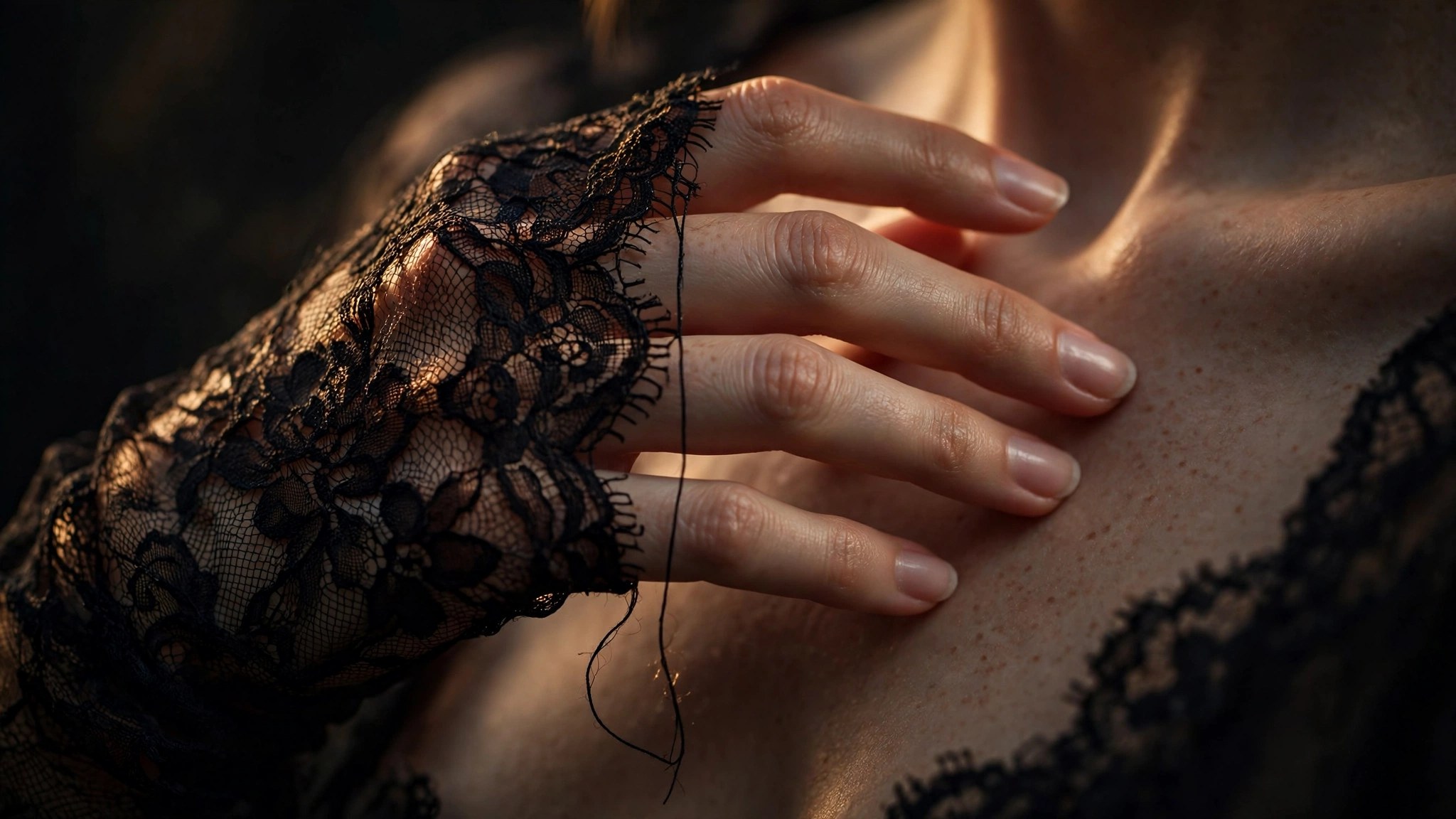
The fix is one texture that breaks the polish. A loose thread on lace. A crease in leather at the knee. A faint red line where a strap pressed into skin. The texture does not need to be large, and it should not be ugly — it needs to be specific. A generic roughness reads as noise. A specific mark reads as a life: this strap was worn, this lace was pulled, this knee bent in this leather yesterday.
Put the texture where the light hits it. A texture in shadow is invisible, and an invisible detail is no detail at all. One raking light across the fabric, one highlight on the skin where the strap sat — that is all it takes. The rest of the image can stay soft. The texture is the one place the image gets sharp, and the eye goes to it the way a hand goes to a rough edge.
5. The gesture: a hand that knows what it is doing
Hands are the hardest thing to generate and the most honest thing in a picture, and that is not a coincidence. A posed hand — fingers arranged, palm displayed, nothing held — is a mannequin hand, and the viewer knows it in a glance. A working hand — a thumb pressing a strap into place, fingers curling around a glass, a knuckle brushing a collarbone — is a person doing something, and the viewer believes the rest of the body because the hand is busy.
Give the hand one job and one object. Holding a ribbon. Turning a page. Tracing a seam. The job should be small enough to read in one second and real enough that a real person would do it in this scene. If you cannot name what the hand is doing in five words, the hand is posing, and posing hands are the first thing that breaks a fantasy.
The gesture also sets the mood of the image, because a hand tells the viewer how the character feels about her own body. A hand that grips is tense. A hand that rests is sure. A hand that touches a collarbone lightly is inviting. Choose the gesture for the feeling first and the pose second, and the image will carry the mood without a single word in the prompt about mood.
6. Placing the detail where the eye lands first
A perfect detail in the wrong place is wasted. The eye lands on the face first, then the neckline, then the hands — in that order, varje gång. A detail at the face or the throat is seen before anything else. A detail at the hands is seen second. A detail anywhere else is found only if the viewer is already interested, which means it cannot do the job of making them interested.
So put the selling detail on the path the eye already travels. A ribbon at the throat. A loose thread at the neckline. A ring on the hand that is already raised. The detail should sit where the viewer is already looking, not where you wish they would look. The rest of the image can be quiet. The detail is the one loud thing, and loud things belong where the eye lands.
7. When the detail becomes the problem
A detail can fail in two directions, and both look the same at first: the image stops reading as a scene. Learn to tell them apart before you re-roll.
Too little detail. The image is clean, polerad, and empty. Everything is correct and nothing is true. The fix is to add one specific thing with wear on it — a frayed edge, a crease, a working hand — and to put it where the eye lands first. Do not add more costume. Add one mark of use.
The wrong detail. The detail belongs to a different scene — a modern watch on a vintage character, a brand logo on a prop, a gesture that belongs to a different mood. The wrong detail does not just fail to sell the fantasy; it actively breaks it, because the viewer now has proof the scene is assembled. Cut it, even if it is beautiful. A beautiful wrong detail is still wrong.
8. What the detail costs
A detail costs almost nothing to add and a great deal to get right, because the cost is not in credits — it is in attempts. A first generation usually gets the big things right and the detail wrong: the ribbon is perfect, the glove is new, the hand is posing. Budget for three to five attempts on a new detail, and fewer once you know which detail sells a given niche. The numbers on this site are simple. A standard text-to-image generation costs 6 krediter. An image-to-image or template generation costs 49 krediter. An undress costs 21 krediter, and a Face Swap Pro costs 26 krediter. A 5-second video template costs 351 krediter, and an 8-second video template costs 561 krediter. Credits come in two one-off packs: $19.99 för 1,000 krediter, which works out to $0.020 per credit, och $59.99 för 5,000 krediter, which works out to $0.012 per credit. Both packs are one-off purchases with instant delivery. There are also annual packs at $119.88 och $359.88, paid once, with credits issued monthly across twelve months. Priser kontrollerade 13 nov 2026. You can try free credits to start, with no credit card required.
Do the arithmetic before you start. Five standard attempts at a new detail cost 30 krediter, which is $0.60 at the $19.99 pack rate. Five image-to-image attempts cost 245 krediter, which is $4.90 at the same rate. The expensive mistake is not the re-roll — it is re-rolling without changing the detail. Write the change down before each re-roll: one thing frayed, one thing creased, one hand given a job.
9. Honest limitations
One detail cannot save a broken image. If the costume is wrong, the pose is wrong, and the light is wrong, a frayed ribbon will not fix any of it — it will just be a frayed ribbon on a broken image. The detail is the last ten percent, not the first ninety. Get the big things right first, then add the detail that makes them believable.
Finally, a detail that works once may not work twice. The seed changes, the light changes, and the ribbon that read clearly in one generation may vanish in the next. When a detail works, save the exact wording that held it — the phrase that kept the fray, the crease, the gesture — so the next image starts from a working recipe instead of from memory.
10. Consent and safety
Generate only yourself or a fictional adult character. Never use a real person’s photo as the base for an image, never recreate a real identifiable person, and never generate an image of anyone who has not consented. Fictional characters must be adults — write the age into the prompt (“in her late twenties”) and check the result before you use it. If a render reads younger than you intended, do not ship it. Regenerate with stronger adult markers or drop the image.
Keep your source photos private. Uploads are deleted 24 hours after upload once all referencing jobs have finished. Keep the original on your own device and treat the upload as a working copy, not an archive.
Slutomdöme
The fantasy is sold by one small true thing. Pick the detail before you write the prompt — a prop with wear, a texture the eye can feel, or a hand with a job — put it where the eye lands first, and give it one light and one shadow to stand in. Everything else in the image can be simple. The detail is what makes the viewer stop checking and start believing, and one detail, done well, is worth more than a whole wardrobe done perfectly.
Frequently asked questions
What is the one detail that sells a fantasy image?
One small thing that feels unmistakably true: a frayed ribbon, a creased leather, a hand doing a real job. It is the evidence that the scene has a past, and it is what makes the viewer stop checking and start believing.
Should the detail be a prop, a texture, or a gesture?
Any one of the three works. A prop proves history, a texture proves the body, and a gesture proves a person. Pick the one that belongs to your character, and do it well — one detail, done well, beats three done halfway.
Where should the detail go in the frame?
Where the eye lands first: ansiktet, the throat, the neckline, then the hands. A detail anywhere else is found only if the viewer is already interested, which means it cannot do the job of making them interested.
Why does my image look polished but empty?
Because everything in it is correct and nothing in it is true. Add one specific mark of use — a frayed edge, a crease, a working hand — and put it where the eye lands first. Do not add more costume.
What if the detail keeps disappearing in new generations?
Fine wear is exactly what models smooth away. Simplify the detail instead of repeating it louder: one loose thread, one crease, one clear gesture. A detail that survives three generations is one the model can draw reliably.
Can too much detail hurt an image?
Ja. A prop in each hand and texture everywhere turns the image into a catalogue, and the viewer stops seeing a person and starts counting objects. Cut everything except the one detail that belongs to the character.
Fortsätt läsa: Two Niches, One Image: Crossing Fantasies Without Losing Either · Write the Character Sheet: One Page That Keeps Your Fantasy Consistent · From Vague Fantasy to Generatable Brief: Writing Down What You Actually Want
Try the detail on your next character in the AI-porrgenerator, or rework a finished image in the AI-bildredigerare. More tools are listed on the AI-porrverktyg page.