

Two Niches, One Image: Crossing Fantasies Without Losing Either (2026)
快速結論: Mixing two niches in one image works when one of them leads and the other one accents. Give both niches equal weight and the image reads as neither: the vampire loses her fangs to the neon, and the cyberpunk loses her city to the lace. Pick the anchor first, let the second niche change only three things, and judge the result by whether a stranger could name both niches from one look. 價錢已核對 13 11月 2026.
Contents
- Why two niches in one image is harder than it looks
- What each niche gives up
- Pick the anchor niche first
- The crossover test: five questions before you generate
- Three crossing patterns that work
- When the cross fails, and how to tell which niche broke it
- What a crossover costs
- Honest limitations
- Consent and safety
- Frequently asked questions
| Crossing pattern | What leads | What accents | Best when |
|---|---|---|---|
| Lead + accent | One niche, fully built | The second niche, in three details | You want both niches readable at a glance |
| Shared setting | The place both niches could meet | Costume and light from each niche | The niches share a mood but not a wardrobe |
| Shared mood | One feeling, two sources | One visual cue per niche | The niches are far apart and need a bridge |
| Equal split | Neither | Neither | Almost never — the image reads as neither |
| One image, two niches | Your anchor | Your accent | You can name both niches from one look |
1. Why two niches in one image is harder than it looks
One niche is easy to generate. You know the costume, 光, the mood, and the model knows them too, because a single niche is a bundle of things that usually appear together. Two niches in one image is a different job. You are asking the model to hold two bundles at once, and the bundles fight: the gothic dress wants candlelight and the cyberpunk wants neon, the vintage gown wants a soft studio and the vampire wants a crypt. The model resolves the fight by dropping whatever is hardest to draw, and what it drops is usually the detail that made the second niche worth adding.
The result is the most common failure in crossover work: an image that is technically fine and thematically blank. It looks like a woman in a nice dress in a dark room. You can see the dress. You cannot see the cross. The whole point of two niches, one image is that a stranger should be able to name both niches from a single look, and if they can only name one, the cross did not happen — you just generated the first niche with a bit of noise from the second.
The fix is not a better prompt. It is a decision made before the prompt: which niche leads, which niche accents, and what exactly the accent is allowed to change.
2. What each niche gives up
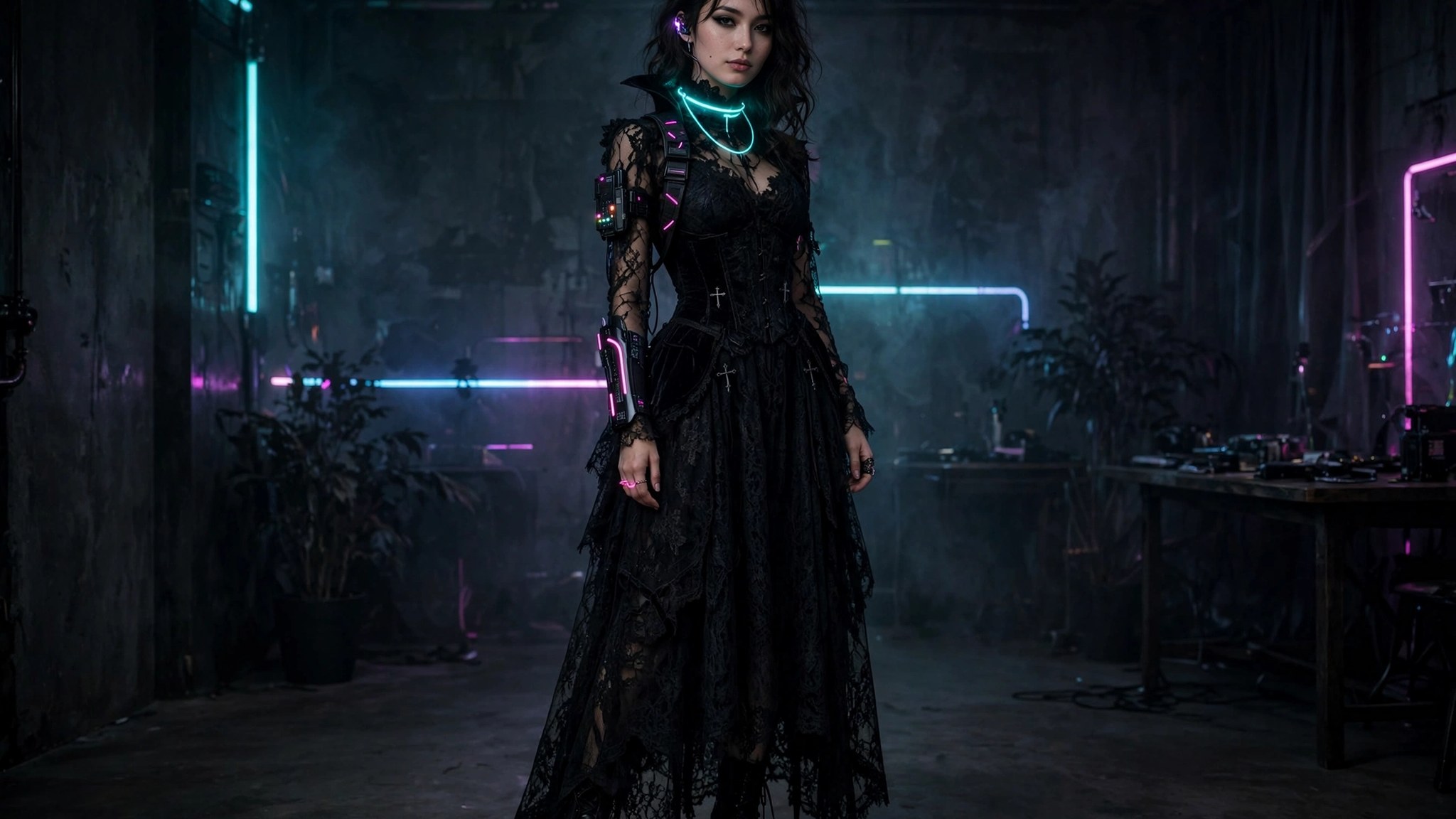
Every niche is a bundle of costume, 場景, light, 以及氛圍. A crossover works when you take the full bundle of one niche and only the most recognisable part of the other. The part you take has to be small enough to survive and loud enough to read. A neon collar on a gothic dress reads. A whole neon city behind a gothic dress does not — the city eats the dress, and the dress stops being gothic.
So the first question is not “what do I add” but “what does each niche give up”. The anchor niche gives up nothing: it keeps its costume, its light, and its mood. The accent niche gives up its setting and its light, and keeps one or two costume details and one mood. That is the trade, and it is the same trade every time, no matter which two niches you cross. If you refuse the trade and try to keep both bundles whole, you get the blank image: two wardrobes arguing in a dark room.
3. Pick the anchor niche first
The anchor is the niche the image is about. It sets the costume, 光, and the mood, and it is the niche a stranger would name first if you showed them the image for three seconds. Pick it before you write the prompt, and pick it by asking which niche you would keep if you could only keep one. The answer is usually obvious, and the obvious answer is usually right: the anchor is the niche you care about most, the one the image exists for.
The accent is the niche that changes the anchor. It should change exactly three things. Three is small enough to hold and large enough to read: one costume detail, one light detail, one mood detail. A neon collar, a cold rim light, a harder stare. Four or five changes and the accent starts competing with the anchor; one or two and nobody notices it is there. Three is the number to aim for, and it is worth counting on your fingers before you generate.
4. The crossover test: five questions before you generate
Before you spend a credit, run the cross through five questions. They take two minutes and they catch most failures before the generation does.
One: can you name both niches in one sentence? “A vampire in a neon city” works. “A gothic cyberpunk vintage thing” does not — if you cannot say it plainly, the model cannot draw it plainly either.
Two: does the accent change exactly three things? Name them. If you cannot name them, the accent is a feeling, and feelings do not survive generation.
Three: would the image still work if the accent were removed? If the answer is no, the anchor is weak and the accent is carrying the image. Strengthen the anchor first.
四: do the two niches share a mood? Gothic and cyberpunk share dread and night. Vintage Hollywood and vampire share drama and shadow. Niches that share a mood cross easily; niches that share nothing need a bridge, which is the next section.
Five: what will you cut first if the image comes back muddy? Decide the cut before you generate. When the image fails, you will know exactly what to remove instead of staring at it and re-rolling blindly.
Five yeses and the cross is ready. A no anywhere is a prompt you have not finished writing yet.
5. Three crossing patterns that work
Most successful crosses use one of three patterns. Pick the pattern before you pick the details.
Lead + accent. The anchor is fully built; the accent changes three details. This is the default pattern and the one to use when the niches are close — gothic and cyberpunk, vintage and vampire. It is also the easiest to judge, because the anchor is obvious and the accent is countable.
Shared setting. The two niches meet in a place both could plausibly occupy: a nightclub, a theatre, a rainy street. The setting does the crossing, and the costume and light come from each niche. Use this when the niches share a mood but not a wardrobe — the setting gives them a reason to be in the same frame.
Shared mood. The niches are far apart and need a bridge. Pick one feeling both niches can carry — dread, longing, defiance — and let each niche contribute one visual cue to that feeling. A vampire’s stare and a neon sign can both carry dread. The image works because the feeling is coherent even though the wardrobes are not. This is the hardest pattern and the most rewarding when it lands, because the cross itself becomes the subject.
What does not work is the equal split: half of one niche and half of the other, with no anchor and no bridge. The equal split is the pattern people reach for first and the one that fails most. Two half-niches do not add up to one whole image.
6. When the cross fails, and how to tell which niche broke it
Crosses fail in two ways, and the fix depends on which one you have. Learn to tell them apart before you re-roll.
The anchor failed. The image looks like the accent niche, or like neither. The gothic dress is gone and all you can see is neon. The fix is to strengthen the anchor: more of its costume, more of its light, and cut one accent detail. Do not add more anchor words to the prompt — add one concrete anchor detail, the most recognisable thing the niche owns, and remove one accent detail to make room for it.
The accent failed. The image looks like a clean single-niche generation and the accent is invisible. The fix is the opposite: the accent details were too small or too generic. A “neon accent” is generic; a “thin cyan collar light” is a detail. Make the accent concrete and put it where the eye lands first — the face, the neckline, the hands — not in the background, where the model will happily lose it.
Both failed. The image is a dark room with a woman in it. Both niches are gone. This is usually a prompt problem, not a niche problem: the prompt listed two niches and described neither. Go back to the one-line trade from section two and write the prompt from that, not from the titles of the niches. “Gothic” is a title. “Black lace, candlelight, a high collar” is a description, and descriptions are what the model can draw.
7. What a crossover costs
A crossover costs the same as any other generation, but it costs more generations, because a cross that lands on the first try is rare. Budget for three to five attempts on a new pair of niches, and fewer once you know the pair. The numbers on this site are simple. A standard text-to-image generation costs 6 點數. An image-to-image or template generation costs 49 點數. An undress costs 21 點數, and a Face Swap Pro costs 26 點數. A 5-second video template costs 351 點數, and an 8-second video template costs 561 點數. Credits come in two one-off packs: $19.99 為 1,000 點數, which works out to $0.020 per credit, 同 $59.99 為 5,000 點數, which works out to $0.012 per credit. Both packs are one-off purchases with instant delivery. There are also annual packs at $119.88 同 $359.88, paid once, with credits issued monthly across twelve months. You can try a free image preview per IP with no sign-up, and no credit card is required for that preview.
Do the arithmetic before you start. Five standard attempts at a new cross cost 30 點數, which is $0.60 at the $19.99 pack rate. Five image-to-image attempts cost 245 點數, which is $4.90 at the same rate. The expensive mistake is not the re-roll — it is re-rolling without changing anything. Write the change down before each re-roll: one anchor detail stronger, or one accent detail cut.
8. Honest limitations
A crossover cannot make two niches equally strong. One of them will always lead, and the other will always be an accent, because an image has one composition and one centre of attention. If you want both niches at full strength, generate two images, not one. The cross is a compromise, and the honest version of the compromise is that the anchor wins.
Some pairs do not cross. Niches that share no mood, no setting, and no visual language will fight in every generation, and no amount of prompt engineering fixes a pair that has nothing in common. The five-question test in section four will usually tell you before you spend credits. Trust it: a pair that fails all five questions is not a challenge, it is a warning.
Finally, a cross that works once may not work twice. The seed changes, the light changes, and the accent that read clearly in one generation may vanish in the next. When a pair works, save the exact prompt and the exact seed behaviour you observed — the wording that held, the details that survived — so the next cross starts from a working recipe instead of from memory.
9. Consent and safety
Generate only yourself or a fictional adult character. Never use a real person’s photo as the base for an image, never recreate a real identifiable person, and never generate an image of anyone who has not consented. Fictional characters must be adults — write the age into the prompt (“in her late twenties”) and check the result before you use it. If a render reads younger than you intended, do not ship it. Regenerate with stronger adult markers or drop the image.
Keep your source photos private. Uploads are deleted 24 hours after upload once all referencing jobs have finished. Keep the original on your own device and treat the upload as a working copy, not an archive.
Frequently asked questions
What is a niche crossover?
One image that carries two niches at once: an anchor niche that sets the costume, light, 以及氛圍, and an accent niche that changes exactly three details. A stranger should be able to name both niches from one look.
Which niche should lead?
The one the image is about — the niche you would keep if you could only keep one. It sets the costume, 光, and the mood, and it must be unmistakable on its own, without the accent.
How many details should the accent change?
Three: one costume detail, one light detail, one mood detail. Four or five and the accent starts competing with the anchor; one or two and nobody notices it is there.
Why does my crossover look like neither niche?
Usually because both bundles were kept whole and they fought. Give the anchor everything and the accent only its most recognisable details, and write the trade down before you generate.
What if the two niches share nothing?
Use the shared-mood pattern: pick one feeling both niches can carry and let each contribute one visual cue to it. If they share no mood either, the pair probably does not cross — generate two images instead.
How do I know which niche broke a failed cross?
If the image looks like the accent or like neither, the anchor failed — strengthen one anchor detail and cut one accent detail. If the image looks like a clean single-niche generation, the accent failed — make the accent concrete and put it where the eye lands first.
繼續閱讀: Write the Character Sheet: One Page That Keeps Your Fantasy Consistent · From Vague Fantasy to Generatable Brief: Writing Down What You Actually Want · Too Niche to Generate? When Your Fantasy Is Too Specific and How to Widen It
Try a crossover on your next character in the AI 色情生成器, or rework a finished image in the AI 圖片編輯器. More tools are listed on the AI 色情工具 page.