

Generic prompts make generic porn. “A beautiful woman” gives you the same woman everyone else gets: the same face, the same room, the same light, the same pose. It works, and it is boring. The moment you want something specific — a particular body type, a particular era, a particular mood, a particular scenario — the generic prompt stops working, and you need a different skill: describing a niche precisely enough that the model can build it.
This guide is about niche tastes: how to generate the exact style, scenario, and look you actually want, instead of the average of everything the model has seen. It covers the four levers that make a niche work — specificity, reference, style, and subtraction — and the five mistakes that turn a specific idea into a generic render.
Quick verdict
A niche is a list of specifics, not a vibe: name the body, the era, the setting, the light, and the mood in concrete words, anchor it with a reference image, pick the style that fits it, and subtract everything you do not want.
In this guide
- 1. Why generic prompts fail niches
- 2. Specificity: name it, don’t vibe it
- 3. Reference: anchor the niche
- 4. Style: realistic, anime, 3D — pick by the niche
- 5. Subtraction: the negative prompt
- 6. Scenario: setting is half the niche
- 7. Iteration: one change at a time
- 8. Five mistakes that genericize a niche
- 9. Cost: what a niche run is worth
- 10. Consent: the rule that decides everything
- FAQ
1. Why generic prompts fail niches
A model is an average machine. Give it a vague prompt and it gives you the average of everything it has seen: the most common face, the most common body, the most common room, the most common light. That average is not bad — it is smooth, polished, and familiar, which is why generic prompts feel like they work. But it is nobody’s taste.
A niche lives in the details the average throws away. The average woman is twenty-five, slim, with long dark hair, in a white room. Your niche might be a woman in her forties, with freckles and grey streaks in her hair, in a cluttered kitchen at dusk. Every word the average prompt leaves out is a word the model fills in with the average — and each one pulls the result further from what you wanted.
The fix is not a better model. It is a better description. The model already knows what freckles look like, what dusk light looks like, what a cluttered kitchen looks like — it just does not know you want them until you say so.
2. Specificity: name it, don’t vibe it
Specificity is the first lever, and it has one rule: name it, don’t vibe it. “Sultry” is a vibe; the model has a thousand versions of it, and it will pick the most common one. “A woman in her late thirties, freckles across her nose, auburn hair tied back, wearing a linen shirt, sitting at a kitchen table at dusk” is a list of specifics; the model has far fewer versions of that.
Build the description in five blocks: body, face, hair, outfit, and setting. One concrete detail per block is enough to start — “broad shoulders”, “a small scar above the eyebrow”, “grey-streaked hair”, “a denim jacket”, “a laundromat at night”. Each block narrows the average a little further, and five blocks narrow it a lot. Two details per block is better; three is usually too many.
Use words the model can see. “Beautiful” is not visible — the model cannot tell what you mean by it, so it substitutes the average. “Freckles”, “auburn”, “denim”, “dusk” are visible: each one is a thing the model can draw. If a word does not change what the picture looks like, it does not belong in the prompt.
3. Reference: anchor the niche
A reference image is the fastest way to make a niche specific. Words can describe a face; a photo shows it. Upload a reference — a photo of yourself, or a generated image that is close to what you want — and the model has an anchor: this face, this body, this light, this room.

Use the reference for the hard part. Faces and bodies are the hardest things to describe in words and the easiest things to show in a photo. Settings and moods are the opposite: easy to describe, hard to show. So anchor the face and body with the reference, and describe the setting and mood with words.
One warning: a reference is an anchor, not a photocopy. The model will keep the face and the general look, but it will not reproduce the reference exactly — and it should not. If you want the reference’s face in a new scene, use the reference plus a prompt that describes the new scene. The anchor holds the person; the prompt moves them.
4. Style: realistic, anime, 3D — pick by the niche
Style is the third lever, and it decides what the niche can be. Realistic is the hardest style and the most rewarding for niches built on real details: freckles, wrinkles, grey hair, lived-in rooms. The eye knows what real skin looks like, so a realistic niche has to get the details right — but when it does, it looks like a photograph of a real person. Anime is the most forgiving: the style itself is a simplification, so a niche built on a mood, a colour palette, or a character type works better in anime. 3D sits in between: volume and light like a photograph, but a smoother surface the eye accepts.
Pick the style by what the niche is made of. If the niche is a real detail — a scar, a tattoo, a body type, an age — pick realistic, and spend your words on the detail. If the niche is a mood or a character — a shy schoolteacher, a cyberpunk hacker, a fantasy elf — pick anime, and spend your words on the character. If the niche is a look — glossy, sculpted, dramatic light — pick 3D, and spend your words on the light.
Do not judge one style by another’s standard. An anime niche fails when the lines are muddy or the colours are wrong, not when the skin lacks pores. A realistic niche fails when the skin is waxy or the light has no direction.
5. Subtraction: the negative prompt
Subtraction is the fourth lever, and it is the one most people skip. A negative prompt tells the model what not to draw: no glasses, no tattoos, no bright colours, no smile, no modern furniture. Every word in it removes something the average would otherwise add — and for a niche, what you remove matters as much as what you add.
Write the negative prompt from the result, not from the idea. Generate once, look at what the average added that you did not want — the wrong hair, the wrong room, the wrong expression — and put those things in the negative prompt. Then generate again. One round of subtraction usually removes the worst of the average; two rounds remove most of it. Our negative-prompt guide on this site has the recipes for the common artifacts, and the same method works for taste: name what you do not want, and it stops appearing.
Keep the negative prompt short. Five to eight items is enough. A negative prompt with twenty items fights the positive prompt: the model spends its attention on what not to draw and forgets what to draw.
6. Scenario: setting is half the niche
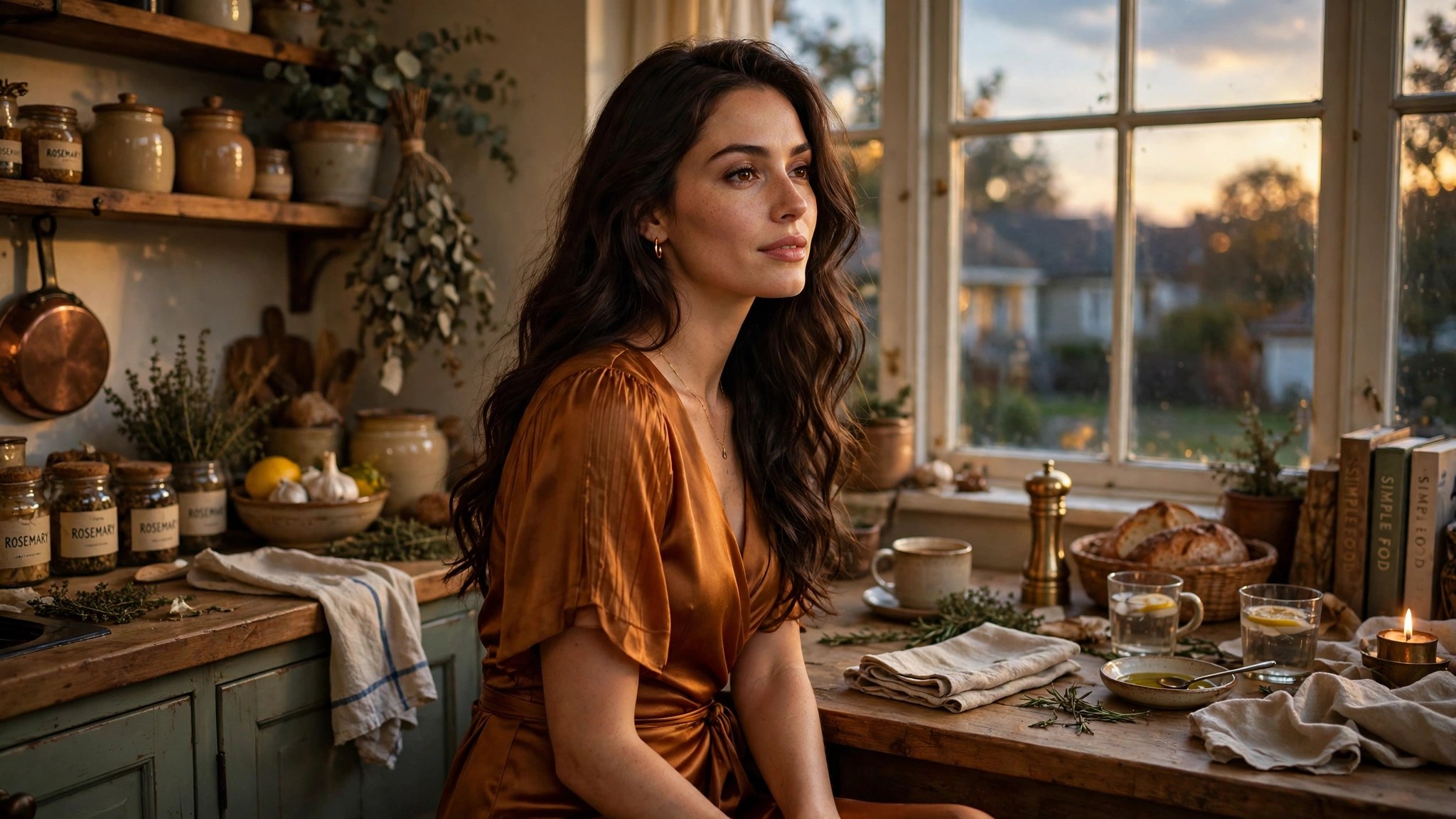
Half of any niche is the setting. The same woman in a white studio and in a laundromat at night is two different images, and the second one is the niche — because the setting is what makes the scene specific. A white studio is the average’s home; it adds nothing. A laundromat at night, a kitchen at dusk, a car in the rain, a library after closing — each one is a place with its own light, its own clutter, its own mood.
Describe the setting the way you describe the body: in concrete words. “A laundromat at night, fluorescent light, rows of machines, a plastic chair, a window with rain on it” is a setting the model can draw. “A moody place” is not. Name the light first — it decides the mood more than anything else — then the room, then one or two objects in it.
And keep the setting consistent with the body. A woman in an evening gown belongs in a ballroom, not a laundromat — unless the mismatch is the point, in which case name the mismatch. The model will not question a strange combination if you describe it confidently; it will question a combination you describe vaguely.
7. Iteration: one change at a time
Iteration is how a niche gets made. Nobody writes the perfect niche prompt on the first try. You write a good one, generate, look at what is wrong, change one thing, and generate again. One change at a time is the rule: change the hair, or change the setting, or change the style — not all three. If you change three things and the result gets better, you do not know which change did it.
Keep the winners. When a run gets one thing right — the face, the light, the room — save it as a reference for the next run, and build on it. A niche is not built in one generation; it is built in five or six, each one keeping what worked and fixing what did not.
Know when to stop. A niche that has been iterated six times and still does not look right is not a prompt problem; it is a reference problem, or a style problem, or a setting problem. Change the lever, not the words.
8. Five mistakes that genericize a niche
- Vibe words. “Sultry”, “sexy”, “beautiful”, “hot” — the model substitutes the average for each one. Replace every vibe word with a visible detail.
- Too many details. Three details per block is too many; the model drops them. One or two per block, five blocks, and stop.
- No reference. Describing a face in words is the hardest job in the prompt. Anchor it with a photo instead.
- Wrong style. A realistic niche in anime, or an anime niche in realistic, fights the style. Pick the style by what the niche is made of.
- Changing everything at once. Three changes, one result, no lesson. One change at a time, and keep the winners.
Fix these five and the average stops winning. The niche is not a secret technique. It is specificity, reference, style, subtraction, and patience.
9. Cost: what a niche run is worth
An image costs about 49 credits — roughly $0.98 on the $19.99 pack and $0.59 on the $59.99 pack. A niche is not one image, though; it is five or six, iterated one change at a time. Budget for that: five images is about 245 credits, roughly $4.90 on the $19.99 pack and $2.94 on the $59.99 pack.
The generator shows the exact cost before you run it, and you can try the generator with a free image preview and no sign-up. Start with the preview: it tells you whether the tool fits your niche before you spend anything.
10. Consent: the rule that decides everything
Only generate images of yourself, or of fictional adults. Never generate an image of a real person without their consent — not a celebrity, not an acquaintance, not a stranger. Non-consensual generation is not allowed, and a generated image is harder to take back than a photo once shared.
This is also practical, not just ethical: images made with consent are usually better inputs and better results. They are shot properly, well lit, front-facing, because the person knew they were being photographed. A stolen or secret photo is usually dark, cropped, or shot from a bad angle.
FAQ
Why do my niche prompts keep coming out generic?
Because vibe words like “sexy” and “beautiful” make the model substitute the average. Replace every vibe word with a visible detail — freckles, auburn hair, denim, dusk light.
What is the best way to make a niche specific?
Five blocks, one or two concrete details each: body, face, hair, outfit, and setting. Anchor the face and body with a reference image, and subtract what you do not want with a short negative prompt.
Which style fits a niche best?
It depends what the niche is made of. Realistic fits niches built on real details like scars, tattoos, and age. Anime fits niches built on mood and character. 3D fits niches built on look and light.
How much does a niche cost to build?
About 49 credits per image — roughly $0.98 on the $19.99 pack and $0.59 on the $59.99 pack. A niche usually takes five or six iterations, so budget about 245 credits. You can start with a free image preview and no sign-up.
Should I change everything at once when iterating?
No. Change one thing at a time — the hair, the setting, or the style — and keep the winners. If you change three things and the result improves, you will not know which change did it.
Can I generate a niche image of a real person?
Only with their consent: use images of yourself, or of fictional adults. Generating an image of a real person without consent is not allowed.
Final verdict
A niche is a list of specifics, not a vibe. Name the body, the face, the hair, the outfit, and the setting in concrete words; anchor the face with a reference; pick the style by what the niche is made of; subtract what you do not want; and iterate one change at a time, keeping the winners. Generic words make generic renders. Specific words make yours.
Keep reading
- Realistic vs Anime vs 3D: Which TitFlik AI Style Fits Your Goal?
- Negative Prompt Recipes to Fix Artifacts in TitFlik AI
- Keep Characters Consistent Across TitFlik AI Sessions